
For North American school bag buyers, back-to-school season is what Q4 is for retailers—it sets the tone for the entire year. In 2025, Langmu delivered hundreds of university backpack shipments to colleges and retail chains across the US and Canada. The following five trends are drawn directly from those orders: not lab forecasts, but actual buying decisions.
I. 16″ Laptop Compartment: Now the Baseline
A few years ago, 15.6″ was the standard. By 2025, orders requiring 16″ laptop compatibility had become the clear majority.
The reason is simple: freshmen who entered in 2023 bought 16″ MacBook Pros, and they’ll use them through senior year. A backpack needs to last longer than one device cycle.
Most established suppliers now maintain mold libraries with 16″-ready tooling. At Langmu, over 30 of our 86 universal molds have been upgraded—buyers can access them based on first-order volume.
II. Water Bottle Pockets: One-Hand Operation is Now Expected
This used to be a “soft recommendation.” By 2025, multiple regional retailers had written it into their supplier manuals.
The test standard is straightforward: a 550ml bottle, inserted and retrieved with one push and one pull while walking. It’s not about complex engineering—it’s about elastic tension and pocket positioning.
Langmu’s production lines have standardized these parameters, and orders passing this test consistently show higher reorder rates.
III. Breathable Back Panels: Match the Feature to the Price Point
Not every order needs a high-end ventilation system. Mass-market backpacks use flat back panels with standard foam padding—costs stay low, and basic comfort requirements are met.
For mid-to-high end positioning, 3D air channel or honeycomb structures offer clear differentiation. They command better pricing and generate fewer complaints during all-day campus use.
Most full-line factories support both solutions. The question isn’t “can you do it”—it’s which approach makes sense for your target price point.
IV. Abrasion-Resistant Corners: A Durability Detail Worth Specifying
Campus environments are mostly hard surfaces. Students set down, lean, and drag their bags constantly. Corner wear is one of the most consistent after-sales issues in the university backpack category—not a defect, just physics.
Solutions are mature. Double-stitched bottom panels cost less and deliver stable lead times. PVC wear corners or reinforced base layers cost a bit more but can reduce abrasion-related complaints to near zero.
Both approaches are widely used. Langmu delivers both solutions in annual volumes well into six figures. Buyers choose based on market positioning; we execute.
V. Reflective Features: K-12 Influence is Reaching University
In 2023–2024, multiple California and New York school districts added “360-degree reflective design” to their K-12 procurement specs. By 2025, this trend had started moving into university channels.
It’s not a legal requirement. But parents helping college-aged kids select backpacks are increasingly treating nighttime visibility as a decision factor—especially for students who walk or bike to class.
Reflective materials and application methods vary by budget and durability needs, but the directional trend is clear. At Langmu, key processes are run by technicians averaging 8+ years of experience, and complaint rates across university backpack orders remain extremely low.
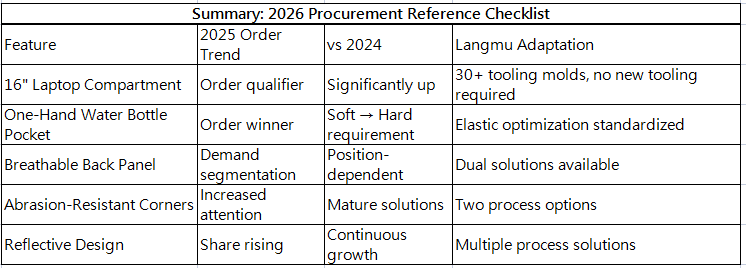
In 2024, buyers were still asking about 16″ lead times. By 2025, the question had shifted to which mold libraries were already upgraded. For 2026, discussions are already turning to next year’s programs.
If you’re sourcing for the upcoming back-to-school season, sending design files or reference styles early helps align expectations on tooling, lead times, and order quantities. Langmu responds with actual capacity and schedules—no more, no less.