
——A Practical Guide for Overseas Procurement Professionals
Last week, I received an inquiry from a California client. He needed school bags for middle school students, with reflective strips that could “survive at least one school year and hold up in machine washing.” After reviewing his design, I asked: “What’s your budget and MOQ?” His answer: “First-time order, 500 units, just to test the market.”
We recommended printed reflective strips. Not because heat transfer is inferior — but because business logic comes first.
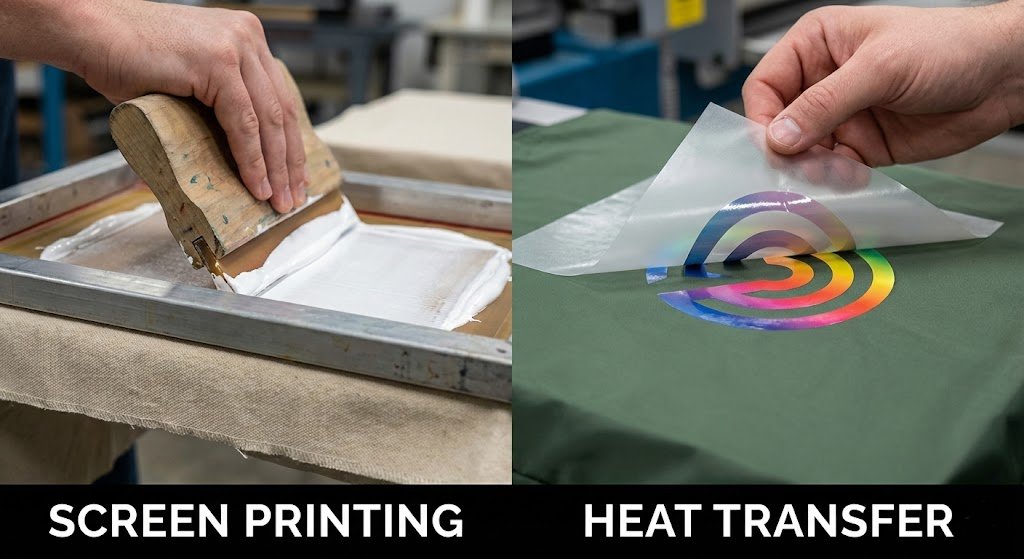
Printed Reflective Strips: The “Low-Cost Entry Ticket” for Trial Orders.
Printing is flexible, fast, and tooling-free.
We can start at 500 units, screen printing plates cost around $50–$80 USD, and production takes 10 days after sample approval.
The trade-off? Wear life is about 4–5 months under daily student use. Edge peeling is expected.
That’s why printing is best suited for: trial orders, short-term projects, or budget-sensitive programs.
Last year, we delivered 800 printed bags for a Brazilian client. He knew the durability limit — but his school contract only had one year left. Printed strips were the perfect fit. Not the “best” technology, but the right one for his timeline.
Heat Transfer Reflective Strips: Long-Term Value for Annual Programs.
Heat transfer embeds the reflective film into the fabric surface. It’s not “stuck on” — it’s fused in.
Test results: 60+ machine washes, edges intact. Complaint rates near zero after a full school year.
The threshold? Our standard MOQ for heat transfer is 1,000–1,500 units.
Why not lower? It’s not about refusing small orders — it’s about tooling amortization and production line efficiency.
A set of heat transfer tooling lasts 50,000+ units. Spreading that cost over only a few hundred pieces drives up per-unit cost unfairly for long-term partners.
Our facility spans 15,000㎡, with 6 production lines and nearly 200 sets of automated equipment. 300+ skilled staff, annual output in the tens of millions of USD.
This scale means our lines run most efficiently at 1,000+ units per order. We *can* do smaller — but we prioritize capacity for clients with long-term programs.
Take heat transfer school bags: last year alone, we shipped over 120,000 units to 37 brand owners and school district procurement partners across North America, Europe, and Southeast Asia.
One Canadian school district started with a 1,200-unit trial, borrowing from our existing mold library.
Year two: 4,500 units reorder, new custom mold opened.
Per-unit cost dropped 12% vs Year 1.
That’s the sweet spot of heat transfer: higher first-order commitment, significantly better economics and quality on reorders.
Three Questions Every Buyer Should Ask.
1. What’s your program timeline?
– One-off or short-term → Printing
– 3+ years committed → Heat transfer
2. Stuck on MOQ? Ask about the mold library.
We maintain 86 universal school bag tooling sets.
For heat transfer, 1,000 units gets you started — tooling loaned free of charge.
Many new buyers don’t know to ask this. It’s our most flexible entry point for mid-sized procurement.
3. Who certifies your abrasion resistance?
Global programs require CPSIA, REACH, ASTM.
Our production lines are regularly audited by SGS, BV, TÜV.
ISO 9001:2015 and BSCI are our baseline — not “premium” features.
What really matters to buyers isn’t how many certificates hang on the wall.
It’s: When the 40ft container arrives, what’s the yield rate?
Last year: 127,000 heat transfer bags shipped. Customer complaint/return rate: under 0.6%.
This isn’t lab data. It’s post-season feedback from students, parents, and procurement officers.
One Sentence Summary.
Trial order? Print.
Annual program? Heat transfer.
Not sure? Send us your design. 24 hours, two quotations.
No technology is “superior” in isolation.
The right choice is the one that fits your order structure, production reality, and long roadmap.