
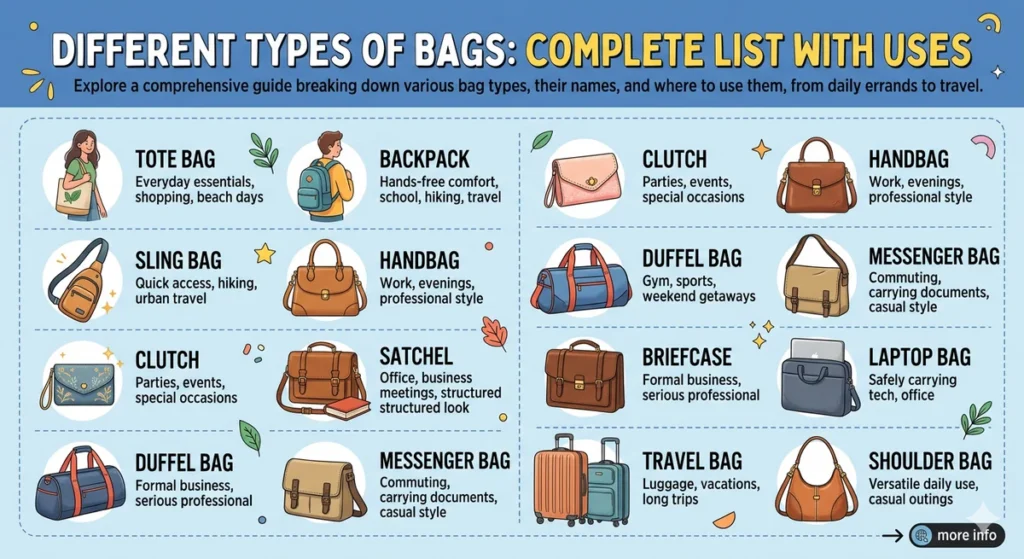
We draft patterns daily—some from sketches on napkins, some from CAD files that took weeks. The pattern determines everything: how the bag stands, what it carries, how much material it burns. Here’s the breakdown for buyers who need to specify more than “make it look like this.”
The Soft Bag Family
Tote Pattern
Simple rectangle, no closure, two handles attached to the body. Sounds basic until you specify depth.
- Flat tote: Front and back panels only, sewn at sides. No depth, papers curl inside. Fast, cheap, minimal material.
- Gusseted tote: Side panels added, creating depth. Rectangular bottom or curved “boat” bottom. Holds shape, carries volume.
- Boxed tote: Bottom panel inserted, corners squared. Stands upright when loaded. More cuts, more seams, more cost.
Pattern complexity jumps fast here. A flat tote is four pattern pieces.
Duffel / Barrel Pattern
Cylindrical or oval cross-section, end caps closing the tube. Classic weekender, gym bag, military kit bag.
Straight barrel: Body is one rectangle wrapped into tube. End caps circular or oval. Simple, but everything pools in the middle when carried.
U-shaped duffel: Flat bottom panel added, creating floor. Better structure, easier packing. Pattern pieces multiply—body, bottom, two ends, plus gussets if you want standing capability.
Strap attachment is the failure point. Sewn only to the body fabric, heavy loads tear out. Good patterns extend straps under the bottom panel or box-stitch through multiple layers. Check your sample’s interior—can you see strap ends, or are they buried in seams?
Backpack Pattern
Three-dimensional by definition. The pattern breaks into:
- Front panel: Usually simplest piece, sometimes with pocket overlay
- Back panel: Contoured for shoulders, often with integrated frame sheet sleeve
- Side panels: Connect front to back, determine depth profile
- Bottom: Rectangular or curved, depending on desired stance
- Flap or closure: Top lid, roll-top, zippered panel—each different pattern logic
The critical pattern element nobody sees: the gusset connecting bottom to sides. Too shallow, bag won’t open wide. Too deep, bag collapses empty. We draft gussets last, after fitting mock-ups, because math doesn’t predict real-world behavior.
Panel loading vs. top loading changes everything. Panel loaders need full perimeter zippers—pattern adds 40% more cut length, hardware cost jumps. Top loaders sacrifice access for simpler construction.
Messenger / Sling Pattern
Asymmetrical by design. Single shoulder strap, body rides high on back or low on hip depending on strap anchor points.
Classic messenger: Rectangular body, flap closure, stabilizer strap across chest. Pattern is straightforward until you add the stabilizer—wrong angle and bag swings anyway.
Sling pack: Teardrop or asymmetrical body, single diagonal strap. Pattern must account for body curve; flat drafting produces bags that gap awkwardly.
The pattern challenge is strap anchor geometry. Attach too low, bag tips outward. Too high, digs into neck.
Bucket / Drawstring Pattern
Cylinder with circular or oval base, cinched at top. Simple concept, tricky execution.
Base circumference must match body width exactly. Shrinkage during sewing throws this off—nylon gains 2-3%, cotton canvas loses 1-2%.
Drawstring channel placement determines closure security. Too close to top edge, bag gapes when loaded. Too low, reduces opening size.
Structured Bags: When Soft Isn’t Enough
Frame-Assisted Patterns
Soft bags with rigid inserts: plastic sheets, aluminum stays, fiberglass rods.
Internal frame: Channels sewn into back panel, stays removable. Pattern must allow insertion without seam ripping, usually via bottom opening or side zipper.
Semi-rigid: EVA foam laminated to fabric, thermoformed to shape. Pattern is flat, final shape comes from heat and mold.
The pattern looks wrong flat—distorted, stretched in places. Only makes sense after forming.
Hard-Shell Hybrid Patterns
Soft body, hard panels. Common in camera bags, drone cases, tool organizers.
Pattern has two states: soft fabric sections that flex, rigid panels that don’t. The interface is critical—sewing through hard plastic requires different needles, different speeds, often different machines. Pattern must group hard-panel attachments together so production doesn’t switch setups constantly.
Zipper placement on hard panels is failure-prone. We specify coil zippers with wide tape, sewn through both tape and panel with reinforced stitches. Standard zippers on hardshell separate under stress; the teeth pop from rigid backing that doesn’t flex.
The Box Family (Cases, Luggage, Hardgoods)
Two-Shell Clamshell
Top and bottom halves, hinged at back, latches at front. Classic briefcase, hard luggage, equipment cases.
Pattern here is actually mold design—thermoformed ABS, injection molded polypropylene, or aluminum extrusion. But the soft goods attachment matters: lining, interior panels, handle mounts.
Critical pattern element is the crush zone where shells meet. Too tight, latch strains. Too loose, water and dust enter. We specify gasket channels in the hardshell, then pattern soft gaskets to fit. Missing this, you get “water-resistant” cases that leak in light rain.
U-Frame Opening
Hard back and sides, soft front panel that zips wide open. Common in technical luggage, medical kits.
Pattern challenge is the transition: hard vertical stays, soft horizontal expansion. Zipper must follow compound curve without binding.
Spinner / Wheeled Upright
Hard or soft shell, vertical orientation, telescoping handle, four corner wheels.
Pattern includes wheel housing integration—cutouts in base panel, reinforcement layers, often metal or high-density plastic inserts. Handle housing similarly complex. These aren’t “details” in pattern terms; they’re primary structural elements that determine if the case survives airline handling.
Wheel placement pattern affects stability. Too close to center, case tips when loaded front-heavy. Too close to corners, wheels snap from lever arm stress. We position from loaded-center-of-gravity testing, not aesthetic symmetry.
Specialty Patterns Worth Knowing
Roll-Top Dry Bag
Cylinder with stiffened top band that rolls and clips. Waterproof by closure geometry, not just coating.
Pattern is simple cylinder until you specify the top: how many rolls before clip? Three minimum for submersion, two for splash protection. Each roll consumes 8-10cm of height—pattern must extend body length accordingly, or finished bag is shorter than specified.
Modular / MOLLE-Compatible
Base bag with external grid for attachment. Pattern includes PALS webbing spacing: 25mm wide straps, 40mm spacing, 20mm gap. Deviate and pouches don’t fit standard accessories.
The pattern complexity is webbing layout—horizontal rows, vertical anchoring, bartack positions every 38mm. Labor-intensive, but buyers expect MOLLE compatibility without understanding the specification.
Convertible / Transforming
Bag becomes backpack becomes duffel. Pattern has multiple states: strap anchor points that relocate, panels that fold or tuck, volume that expands.
These patterns look like origami instructions. Every transformation path must be tested—strap length at each configuration, balance when loaded, whether conversion hardware catches on clothing.
Bottom line: The pattern is the blueprint, the recipe, the DNA of your bag. Skimp on pattern development and you get expensive problems later. Good suppliers invest here; bad ones rush to cutting and hope.
Need pattern review for a design you’re sourcing? Send sketches or samples—we can estimate piece count, flag complexity issues, and suggest simplifications that preserve function while cutting cost.