
Last week, a European procurement director asked a simple, hard question. It wasn’t about pricing, MOLLE compatibility, or fabric denier. He asked, “If I place a $2 million order in June, who will actually deliver in October?”
This is the conversation happening behind the scenes, far from trade show brochures.
The Market Shift
Analyst figures are easy to find. Marketsize.biz values the military tactical vest market at $2.2 billion for 2026, while Research and Markets tracks the broader protective gear segment at $19.25 billion. However, these numbers miss where growth is concentrated.
The tactical survival gear market—specifically the civilian side—grew 6.3% last year, hitting $186 million. This is no longer surplus trickling down. It is a distinct market with distinct expectations: hunters demanding unrestricted plate carriers, overlanders needing durable packs without SOCOM specs, and preppers prioritizing corrosion resistance over IR signatures.
Procurement officers focusing solely on military contracts are missing half the picture.
The Drivers of Demand
Three macro trends are currently driving orders:
Europe’s Rearmament is Operational
European defense spending hit $563 billion in 2025, a 12.6% jump. Germany’s budget increased by 18%. As NATO shifts from “just in time” to “just in case,” stockpiling replaces lean inventory, favoring suppliers with deep production capacity.
The U.S. Budget Threshold
The FY2026 defense budget will exceed $1 trillion for the first time. While this means more RFQs, it also brings stricter compliance scrutiny.
Asia-Pacific Modernization
Regional spending hit $573 billion in 2025. The story is the modernization mandates across the region—from Japan to Singapore—requiring new equipment.
What Buyers Actually Want
Three requirements now dominate:
Weight is Non-Negotiable
It is no longer a preference; it is the first question. For those carrying 40kg for 12 hours, the difference between 600g and 430g is the difference between blisters and performance. Ultra-light carriers (420g–430g) are now table stakes.
Modularity that Works
Buyers are tired of “modular” systems that require 20 minutes of fighting to attach gear. They want systems that reconfigure fast, hold tight during movement, and don’t snag on door frames. Increasingly, they want integration paths for comms, GPS, and even solar. The vest is becoming a platform.
Materials that Justify Themselves
Cordura remains the benchmark, but buyers know the difference between 500D and 1000D. They are asking about flame resistance that doesn’t compromise breathability and stitching that holds when gear fails. One buyer summarized it: “I don’t need marketing. I need to know that when this goes wrong, it’s not because I picked the wrong vendor.”
The Persistent Problems
Despite the demand, buyers face three recurring frustrations:
- The Authenticity Gap: Every supplier claims “military-grade” quality, yet many brochures feature operators in gear they’ve never actually supplied.
- Certification Chaos: Navigating NIJ Level III, European fragmentation standards, REACH compliance, and Berry Amendment traceability across multiple vendors is exhausting.
- Delivery Failures: When safety gear is late, it is effectively “never.” Production delays and shipping bottlenecks remain critical risks.
The Solution: Capability & Capacity
Finding one partner who can handle all of this sounds simple but is hard to execute. Here is how we address these gaps:
Real Capacity
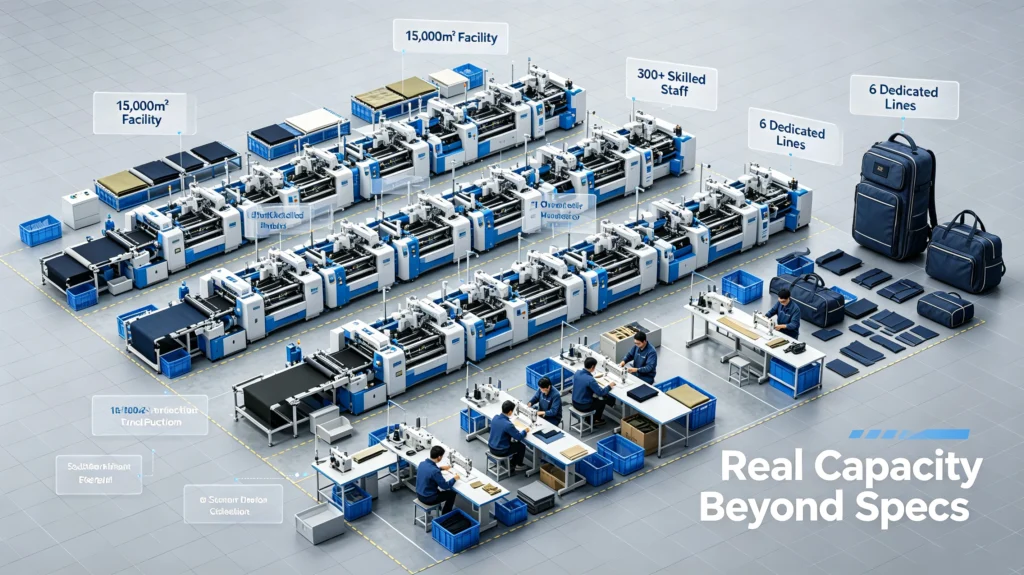
We operate a 15,000 sqm facility with 300+ staff and 6 dedicated lines. When European orders spiked 40% last year, we scheduled another shift—we didn’t scramble.
Verified Certifications
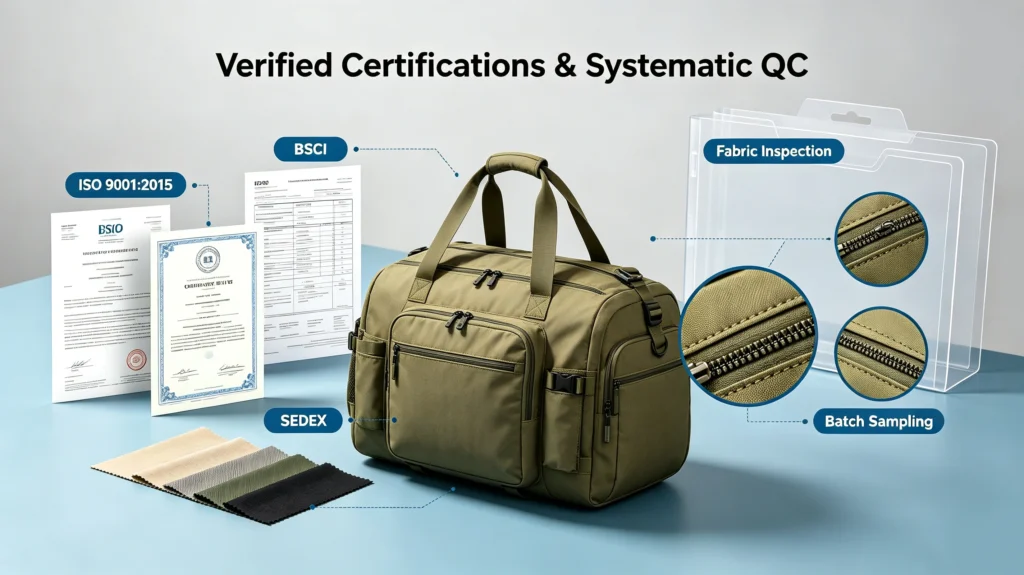
We hold ISO 9001:2015, BSCI, and SEDEX, alongside specific audits from WM, MGB, and SWISSGEAR. We provide documentation, not excuses.
Built for Use
We focus on military packs that distribute weight properly, tactical vests that stay put, and bags that survive gravel and drops. We also handle custom work for specific missions.
Systematic QC
Quality control is not aspirational. We enforce fabric inspections, in-process checks, and batch sampling. One bad shipment costs more than ten perfect ones, so we catch problems before they become yours.
The Separating Moment
This is a structural shift. Defense budgets are up, but procurement windows are tightening. Tariff measures and Europe’s “capability shortfalls” are accelerating nearshoring.
The buyers who lock in capacity early with proven vendors will sleep better. Those still hunting for suppliers who can handle both military specs and commercial pricing will feel the squeeze.
Sourcing for the Future
Based on what we are seeing, here is our advice:
- Look Past Brochures: Visit the facility or demand a video tour. See the actual production lines.
- Verify Certifications: Don’t take anyone’s word; ask for audit reports.
- Test Samples Hard: Test them the way end-users will, not the way marketing hopes.
- Build Relationships: Partner with vendors who have weathered demand spikes before.
We are ready to walk you through our facility and show you a shop floor built for your 2026 orders.
Quanzhou Langmu International Trade Co., Ltd.
Modern Factory: 15,000㎡ · 300+ Staff · 6 Lines · 200+ Automated Systems
Certifications: ISO 9001:2015 / BSCI / SEDEX / WM / MGB / SWISSGEAR