
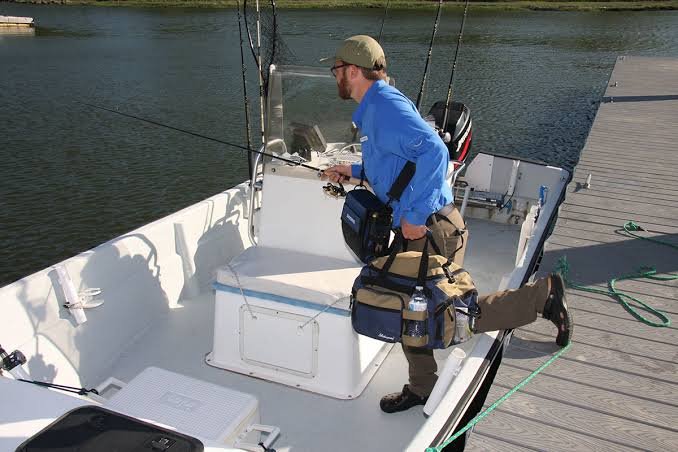
You might think a fishing bag is just a bag. But spend a day by the water, and you will see the opposite. Some anglers wear a tiny waist pack and move like ghosts along the bank. Others carry a backpack so big you wonder if they are camping for a week. Neither is wrong – they are just fishing different ways.
So what really separates small, medium, and large tackle bags? It is not only about how many lure boxes you can stuff inside. It comes down to how someone fishes: where they go, what they chase, how long they stay, and how much they are willing to carry.
If you are a brand owner, a distributor, or a retail buyer, knowing these differences helps you stock the right bags for your customers. Let us walk through each size – what works, what does not, and who actually buys them.
Small Fishing Bags: The Minimalist’s Companion
Small tackle bags (typically under 5 liters) include waist packs, chest packs, and small singlestrap sling bags. They are designed for anglers who value mobility over everything else.
Key features:
- Ultralightweight construction – often under 0.5 kg when empty.
- Deep organizational pockets, sometimes with builtin hookandloop panels for attaching lure boxes.
- Waterresistant materials because small bags are often worn close to the body.
- No exposed zippers or loops that could snag on branches or fishing line.
Pros & Cons:
Pros: Extremely portable, encourages discipline, perfect for hiking to remote spots.
Cons: Limited capacity – you cannot carry spare reels, large bait containers, or rain gear.
Medium Fishing Bags: The Versatile Workhorse
Medium bags (roughly 5 to 30 liters) are the most common category. They include standard tackle backpacks, small rod bags, and multicompartment shoulder bags. This is where most anglers start – and often end – their search.
Key features:
Inside, there is usually room for three or four standard tackle trays – the common 3600 or 3700 sizes. That is enough for a solid selection of lures, hooks, and weights without going overboard.
You will also find several external pockets. These are handy for things like pliers, a spool of leader material, your snack bar, sunblock, or a small water bottle. No need to open the main compartment for every little thing.
The shoulder straps are padded, and some models add a waist belt. This makes a real difference when you have been walking the bank for a couple of hours – the load stays on your hips instead of digging into your shoulders.
A nice bonus is the rod holder or the pair of Drings that let you attach a rod tube. That keeps your hands free when moving between spots.
Pros & Cons:
What works well: A medium bag hits a sweet spot. You can pack for a full day on the water – enough gear to handle changing conditions – but you are not lugging a monster pack that tires you out before you even cast a line.
What you give up: It is not meant for long camping trips or carrying extralarge items like a big landing net or a folding chair. If you need to bring the kitchen sink, look at a large bag.
Large Fishing Bags: The Mobile Command Center
Large tackle bags (40 liters and above) are not for everyone, but for those who need them, nothing else will do.
Key features:
Capacity for six or more 3700size tackle boxes plus spare reels, a folding landing net, and even a compact camping chair.
Heavyduty materials – think 1680D ballistic nylon or tarpaulin fabric with welded seams.
Advanced ergonomics: loadlifting straps, aluminum frame stays, and ventilated back panels.
Separate compartments for wet gear (fish, wet waders) and dry gear (phones, spare clothes).
Pros & Cons:
Pros: Unmatched carrying capacity; turns you into a selfcontained fishing unit.
Cons: Heavy – empty weight can reach 2–3 kg. Overpacking is a real risk. Takes up significant storage space at home.
From Concept to Production – Our Factory Advantage
Understanding the subtle differences between small, medium, and large fishing bags is one thing – manufacturing them with consistent quality is another. That is where our facility makes the difference.
At Quanzhou Langmu International Trade Co., Ltd, we operate a 15,000 m² modern factory with over 300 dedicated staff members. Our six conventional production lines and nearly 200 sets of advanced automatic equipment allow us to produce small waist packs, medium backpacks, and large expedition bags under one roof – with the same strict quality control.
We know that a small bag needs tight stitching on narrow curves, a medium bag demands balanced weight distribution, and a large bag requires reinforced stress points. Our production processes are certified to meet ISO 9001:2015, BSCI, SEDEX, WM, MGB, SWISSGEAR, and other international standards. Whether you need a quick sample run of a compact sling bag or a full container order of heavyduty 70L tackle backpacks, we deliver consistent, auditable quality.
Ready to Build Your Own Line?
No matter which size category fits your target audience, we have the engineering experience and production capacity to bring your design to life. Contact us today to discuss samples, custom features, or bulk pricing. Let’s make your next fishing bag a success – small, medium, or large.