
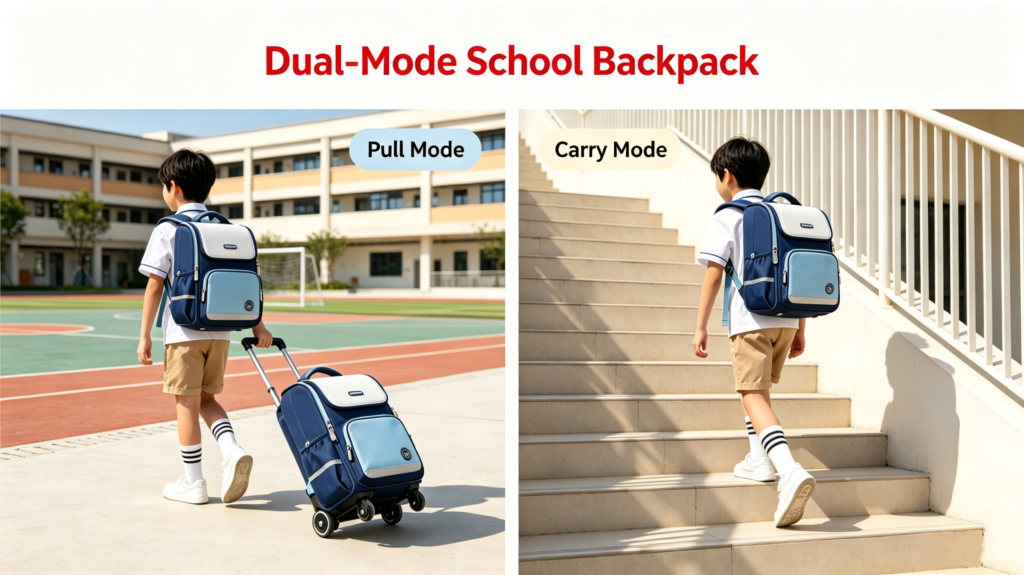
A rolling student backpack – also called a trolley school bag – merges the portability of luggage with the carrying function of a traditional backpack. The following sections highlight its main benefits and the material properties that ensure durability, safety, and everyday practicality.
I. Why Choose a Rolling Student Backpack? 5 Key Benefits
1. Spine-Friendly Relief
Carrying a 5–8 kg schoolbag on young shoulders every day can lead to poor posture and back pain. A rolling backpack transfers the weight from the shoulders to the ground via wheels and a telescopic handle. Children simply pull it – no more leaning forward to balance heavy loads.
2. Ample Space, Thoughtful Layout
With a depth of 18–20 cm, these rolling backpacks have no trouble fitting A4 folders, laptops or tablets, lunch containers, and water bottles. The interior is divided into multiple sections – including a main compartment, a front organizer panel, and mesh side pockets – so stationery, sports gear, and snacks each have their own place.
3. Smooth Mobility on Varied Surfaces
Quiet and stable rolling on pavement, gym floors, and even slightly tilted stairs is made possible by highquality dualwheel systems (PU or rubber) with reinforced bearings. For effortless steering, 360° spinner wheels are also available as an option.
4. Two in One Functionality
When wheels are not allowed (e.g., on a school bus or stairs), retractable shoulder straps turn the trolley into a traditional backpack. No need to carry a second bag.
5. Durability for Daily School Use
School corridors, curbs, and being tossed into lockers are tough on bags. Rolling backpacks built with ripstop fabrics, reinforced bottoms, and wearresistant corner guards are designed to last for years.
II. Materials & Construction – What Makes a Reliable Rolling School Bag?
1. Fabric
Many good rolling backpacks use highdensity nylon (e.g. 420D, 600D, 1680D). These fabrics are lightweight, durable, and waterrepellent. 1680D ballistic nylon is the toughest. Polyester (600D or 1200D) is another common choice.It gives you decent quality for the price, holds its color nicely, and keeps the bag’s shape. For places that see a lot of rain, some designs turn to PVC or tarpaulin – completely waterproof and a breeze to wipe down. And more and more, you’ll see ecofriendly options hitting the market, like recycled PET fabric with GRS certification, made from old plastic bottles.
- Wheels
Most rolling backpacks come with either PU wheels or rubber ones. PU wheels are quiet, don’t leave scuff marks on floors, and roll along smoothly. Rubber wheels handle outdoor pavements and small curbs better – they give you extra grip. A doublewheel setup helps spread the load, makes the bag more stable when you pull it, and cuts down on wear over time. And if the axle has ball bearings? That means the wheels keep turning smoothly for a long time, with less drag to fight against.
3. Telescopic Handle
Highquality handles are usually made of aluminum alloy with a thickness of at least 1.0 mm – light, strong and rustproof. The handle features multistage locking, allowing it to be fixed at different heights to suit children of various ages. The grip is ergonomically designed, wrapped in soft rubber or foam for comfortable pulling.
4. Back Panel & Shoulder Straps
The back panel often combines breathable mesh padding with 5–8 mm EPE foam, effectively reducing back sweat. The shoulder straps are Scurved, padded and equipped with an adjustable chest buckle. When using the trolley mode, the straps can be fully hidden inside a dedicated zipper pocket. All stress points – such as the handle, strap joints and base corners – receive reinforced stitching, typically bartacked or doublestitched.
5. Lining & Hardware
The lining is usually 100% polyester, optionally treated with antibacterial or antiodor finishes. Zippers are often from YKK or SBS, ensuring smooth, jamfree operation. The bottom corners are reinforced with rivets or extra feet to prevent fabric wear from constant floor contact.
III. Quality Control – Common Tests for Rolling Backpacks
Typical quality tests for rolling backpacks include: abrasion test (using Tabor or Martindale equipment); handle cycle test – usually requiring more than 2,000 extensions; wheel rolling and obstacle test – loaded running over 5 km; strap pull test – withstanding at least 50 kg of force; and water repellency spray test to verify fabric performance.
IV. Customization Options for Brands
Common OEM/ODM services available in the industry include: logo embroidery or heat transfer; custom fabric color (Pantone matching); unique wheel colors or printed wheels; adding extra pockets, key fobs or reflective strips; and ecofriendly material choices such as rPET or organic cotton blends.
Conclusion
A welldesigned rolling student backpack is not a mini suitcase – it is a carefully engineered tool that protects children’s spines, organizes their school life, and withstands daily use. Thoughtful design combined with certified materials results in trolley bags that parents trust and children enjoy using.
About Us – Quanzhou Langmu International Trade Co., Ltd
We operate a 15,000 m² modern factory with over 300 dedicated staff members. Our facility features six conventional production lines and nearly 200 sets of advanced automatic production equipment, ensuring high efficiency and strict quality control. Our production processes meet the stringent inspection requirements of various international standards and certifications, including ISO 9001:2015, BSCI, SEDAX, WM, MGB, SWISSGEAR, and others. This commitment to excellence allows us to deliver rolling student backpacks that meet the highest standards demanded by our diverse customer base.