
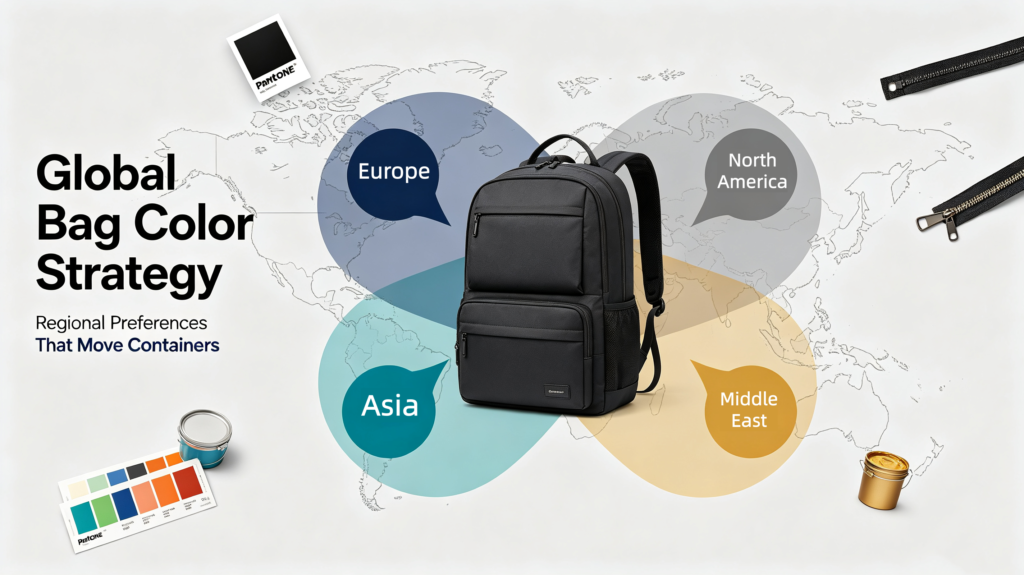
Color choice kills more bag deals than zipper failures. A palette that dominates in Jakarta stalls in Berlin. The same shell shape, identical hardware, different pigment—one moves containers, the other sits in warehouse.
At Quanzhou Langmu International Trade Co., Ltd., our six production lines handle dye batching for markets from Hamburg to Jakarta. Our 300+ staff have learned that regional color preference isn’t design theory. It’s purchase trigger or purchase barrier.
Here’s how color actually functions in global bag markets.
Why Color Fails Cross-Border
Color carries cultural payload. European buyers associate bright saturation with cheapness—school bags, not professional equipment. Southeast Asian consumers read beige and charcoal as institutional, joyless, appropriate for hospital supplies perhaps, not daily carry anticipation.
Market positioning compounds this. A color appropriate for mass retail pet carriers destroys premium tool bag credibility. The same burnt orange signals “affordable fun” in one category, “unprofessional risk” in another.
Trend cycles matter less than assumed. The 2026 “sustainable neutrals” and “minimalist pastels” circulating design blogs influence fashion backpacks, not contractor tool bags. Industrial buyers prioritize visibility and dirt concealment over seasonal palettes.
Regional Color Logic
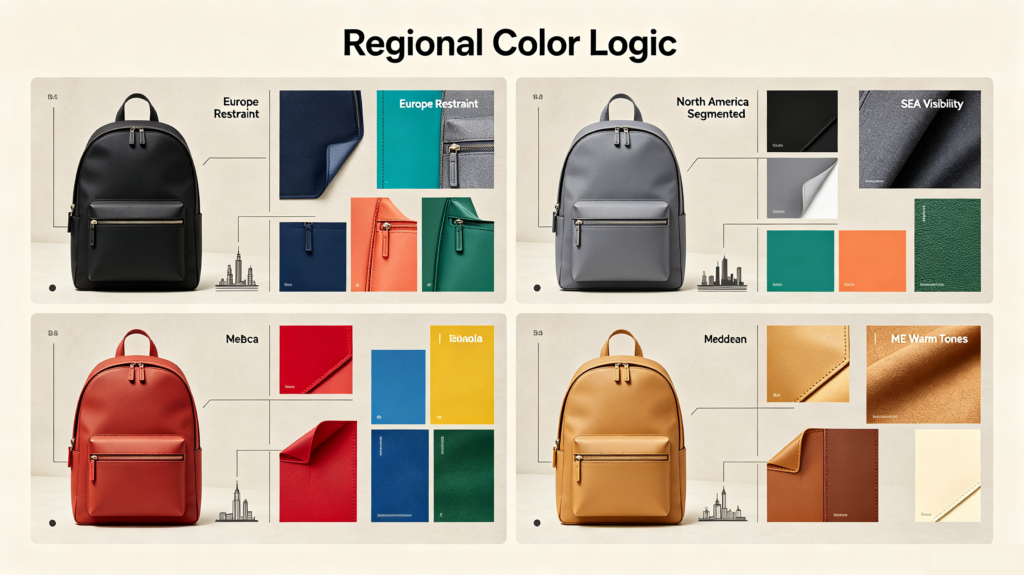
Europe: The Restraint Premium
Northern European markets—Germany, Netherlands, Scandinavia—favor achromatic and near-neutral bases. Black, charcoal, navy, stone. Occasional muted olive or rust as secondary accent. The preference reads as professionalism, durability, versatility across clothing coordination.
Southern Europe tolerates slightly warmer bases—taupe, camel, slate blue—but maintains low saturation discipline. Bright color exists only in lining or tag details, never dominant panel.
Our European-bound production runs default to Pantone Black C, Cool Gray 9C, and 19-4052 Classic Blue. These move through distribution without color-based rejection.
North America: The Segmented Approach
The market splits cleanly by use case. Professional tool bags and business backpacks follow European restraint—blacks, grays, limited corporate logo color integration. Pet carriers, casual daypacks, youth segments accept and expect saturation. Teal, coral, mustard, forest green perform in lifestyle categories.
The error is applying uniform palette across product lines. We’ve seen buyers specify “safe navy” for pet carriers and wonder why PetSmart-level retailers decline. Conversely, burnt orange tool bags sit unsold in industrial distribution.
Southeast Asia: The Visibility Imperative
Heat, humidity, and visual culture drive preference toward high-saturation, high-contrast palettes. Red, royal blue, sunflower yellow, emerald. These register as energy, optimism, and practical visibility in crowded transport environments.
Neutral bags disappear—literally and commercially. A charcoal daypack in Bangkok bus terminal blends with fifty identical pieces. Bright cobalt or tangerine separates immediately.
Our Southeast Asian allocations run Pantone 185C (red), 2935C (blue), 1235C (yellow) as standard bases, with white or black as disciplined secondary.
Middle East: The Warmth Signal
Preference runs toward warm metallics and earth tones—gold, bronze, cognac, chocolate, cream. The association is luxury, heritage, material quality. Cool blues and stark blacks read as cold, institutional, inappropriate for personal investment goods.
Critical constraint: green carries specific religious association in Saudi market contexts. We flag green-dominant palettes for buyer confirmation before batch production.
Manufacturing Color Discipline
Color matching fails practically before it fails culturally. Our 15,000-square-meter facility maintains:
Batch consistency: Automated dye weighing and temperature-controlled vats prevent lot-to-lot variation. Our ISO 9001:2015 protocols include spectrophotometer validation against master standards.
Fastness validation: Rub testing, wash testing, UV exposure simulation. A color that shifts or bleeds becomes a warranty claim and brand damage.
Substrate calibration: Polyester, nylon, and canvas accept pigment differently. Same Pantone specification requires formulation adjustment by material. Our BSCI and SEDEX-certified lines separate dye runs by substrate to prevent cross-contamination.
Hardware coordination: Zippers, pulls, buckles, and trim must color-match or intentionally contrast. We maintain hardware supplier relationships with dye-to-match capability, not just stock black and silver.
Practical Matching Principles
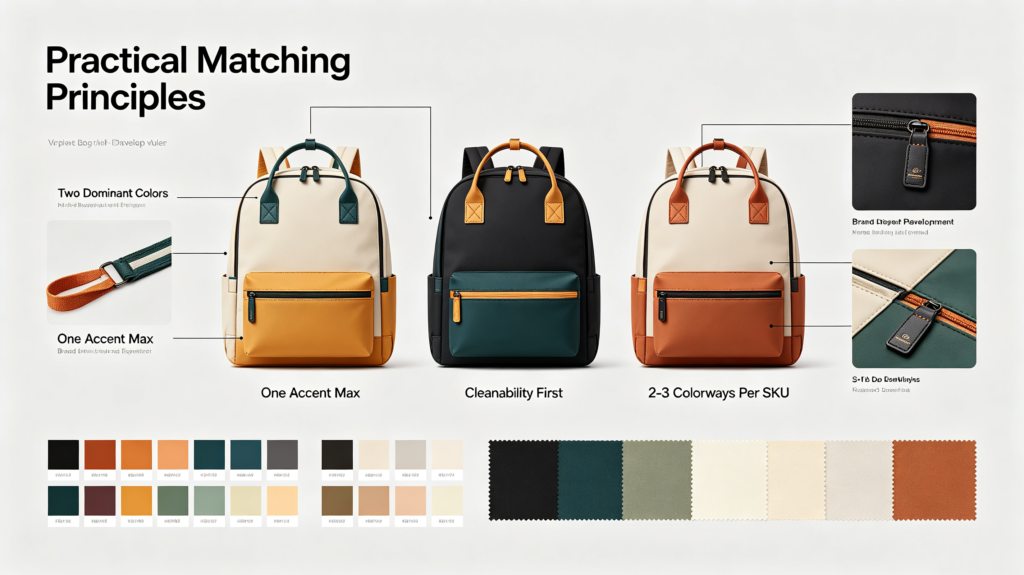
Limit the palette: Two dominant colors, one accent maximum. Three-color collision reads as chaotic in any market.
Brand anchoring: Integrate distinctive brand color into zipper tape, lining, or tag detail. Recognition without dominance.
Cleanability priority: For tool bags and outdoor packs, mid-tones conceal scarring better than black (shows dust) or white (shows everything).
Option architecture: Offer 2-3 colorways per SKU rather than forcing single choice. Distributor testing reveals regional preference without commitment risk.
The Production Reality
Color is the first rejection point and the easiest to prevent. Our WM, MGB, and SWISSGEAR certifications include color documentation requirements—master samples, tolerance specifications, batch validation records.
We run pre-production lab dips for buyer approval before bulk dyeing. The 48-hour delay prevents container-level color disasters.
The right color doesn’t guarantee sale. The wrong color guarantees no sale.
Quanzhou Langmu International Trade Co., Ltd. operates ISO 9001:2015 certified manufacturing with 300+ staff and nearly 200 automated equipment sets. Our 15,000-square-meter facility includes automated color matching and dye batching systems, with BSCI, SEDEX, WM, MGB, and SWISSGEAR compliance. Contact our team for regional color consultation and validated palette development.