

The Costly Misconception
Ninety percent of bag buyers make the same expensive mistake: treating “Oxford fabric” as a specific material rather than a weaving technique. They request quotes for “Oxford fabric bags” without specifying composition or denier, then wonder why samples differ from bulk shipments, why costs spiral unexpectedly, or why quality fails inspection. The core problem is fundamental—Oxford describes how fabric is woven, not what it’s made of. The raw material can be polyester, nylon, cotton, or blends. Without clear specifications, procurement becomes a gamble with inventory risk.
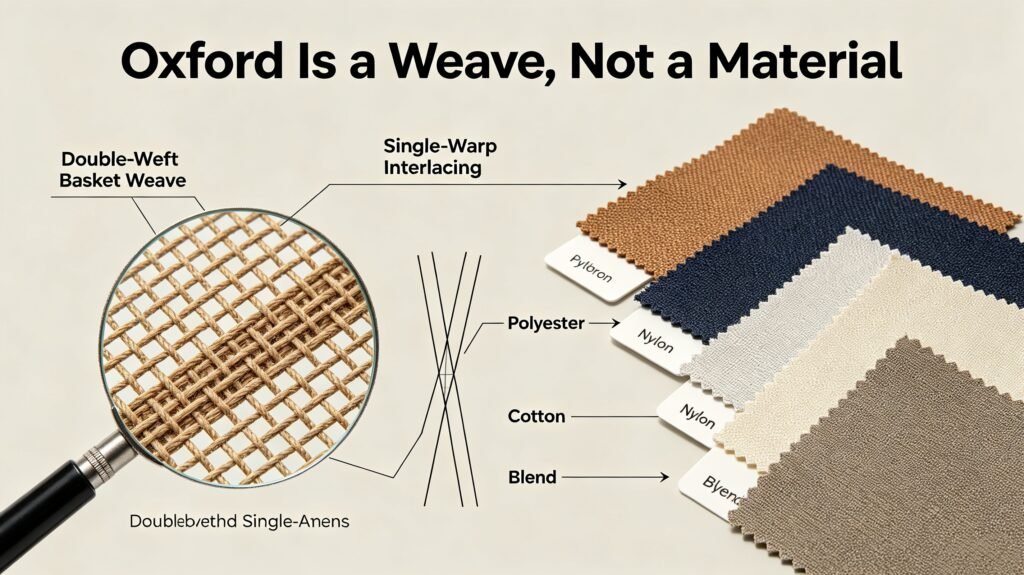
Why “Oxford” Is a Weave, Not a Material
Oxford fabric’s defining characteristic is its double-weft, single-warp basket weave structure—two fine warp yarns interlacing with one thicker weft yarn. This creates the distinctive textured surface and balanced durability. The weaving method originated in 19th-century England for cotton shirting and academic uniforms. The technique persisted; the materials evolved.
Today, 95% of “Oxford fabric” in bag and outdoor gear manufacturing uses synthetic fibers—primarily polyester (polyethylene terephthalate) or nylon (polyamide). The weave structure remains constant while the raw material transforms performance characteristics and cost profiles. This distinction matters critically for procurement: specifying “Oxford” without naming the substrate is like ordering “bread” without stating whether you want wheat, rye, or gluten-free flour. The manufacturing outcome differs radically despite the shared category name.
Common Confusions Buyers Must Avoid
| Misconception | Reality |
| Oxford vs. Canvas | Canvas emphasizes heavy, plain-weave cotton or hemp construction. Oxford emphasizes weave technique and accepts varied thicknesses and compositions. |
| Oxford vs. “Nylon fabric” | Nylon identifies raw material; Oxford identifies weave structure. “Nylon Oxford” is the accurate specification. |
| Oxford vs. Taslan | Taslan employs different weaving patterns (plain or twill) prioritizing lightweight waterproofing, structurally distinct from Oxford basket weave. |
Critical Specifications for Procurement
Effective sourcing requires two non-negotiable parameters:
Material Selection:
- Polyester Oxford: Superior cost-efficiency, abrasion resistance, and waterproof coating compatibility. Ideal for mid-range commuter and casual bags.
- Nylon Oxford: Lighter weight, higher tensile strength, premium price positioning. Preferred for performance outdoor and technical applications.
- Denier Specification (D): The D-number indicates yarn thickness and fabric weight. Higher values mean greater durability and heft:
- 200D: Lightweight, compact applications (small pouches, minimalist designs)
- 420D: Standard commuter and casual backpacks (optimal cost-durability balance)
- 600D: Heavy-duty outdoor and expedition bags (enhanced tear resistance)
- 1680D: Maximum-impact luggage and transport cases (industrial-grade protection)
- Application Matching
| Product Category | Recommended Specification | Rationale |
| Casual/commuter backpacks | 420D polyester Oxford + PU coating | Lightweight, cost-effective, readily waterproofed |
| Outdoor/mountaineering packs | 600D nylon Oxford | High strength-to-weight ratio, abrasion resistance |
| Rolling luggage | 1680D polyester Oxford | Impact absorption, structural integrity for transit handling |
| Lightweight accessories | 200D Oxford (material per budget) | Minimal bulk, portability priority |
Three Sourcing Traps to Eliminate

Trap 1: Unspecified Material Reference Vague “Oxford fabric” orders enable suppliers to substitute polyester for quoted nylon, or vice versa, creating specification drift between sampling and production.
Trap 2: Denier Misrepresentation Low-D fabric (420D) passed off as high-D (600D) delivers insufficient thickness and wear resistance, visibly detectable only after bulk cutting.
Trap 3: “Imitation Oxford” Substitution Non-standard weave structures mimic Oxford appearance but fail on structural integrity—prone to pilling, seam slippage, and premature thread failure.
Professional Communication Framework
Replace ambiguous requests with precise technical language:
- Accurate Inquiry: “Require 600D nylon Oxford, double-weft basket weave, with waterproof coating—quote ex-factory pricing.”
- Quality Specification: “Oxford fabric must specify substrate and denier; provide weave samples; verify no skipped picks or float threads.”
- Verification Question: “What are your warp and weft yarn specifications? Can you provide third-party testing documentation?”
- Supplier Evaluation Protocol
Beyond specifications, assess manufacturing capability through sample burn testing to verify fiber composition, microscopic weave analysis to confirm basket structure integrity, and tensile strength reports against ASTM D5034 standards. Documented quality control checkpoints at greige fabric, post-dyeing, and post-coating stages separate reliable suppliers from trading companies masking subcontractor variability.
Conclusion
Procurement success with Oxford fabric demands specification discipline: weave structure (Oxford) + material composition + denier rating, then pricing and quality terms. The “Oxford” label alone guarantees nothing. Matching technical specifications to product application and budget parameters determines inventory performance.
Our company manufactures certified Oxford fabric bags across full specification ranges—from 200D lightweight polyester to 1680D heavy-duty nylon—with verified weave integrity and coating performance. We provide complete material documentation, third-party testing reports, and sample validation support for wholesale buyers. Contact our technical team to review specifications or request compliance certificates tailored to your market requirements.