
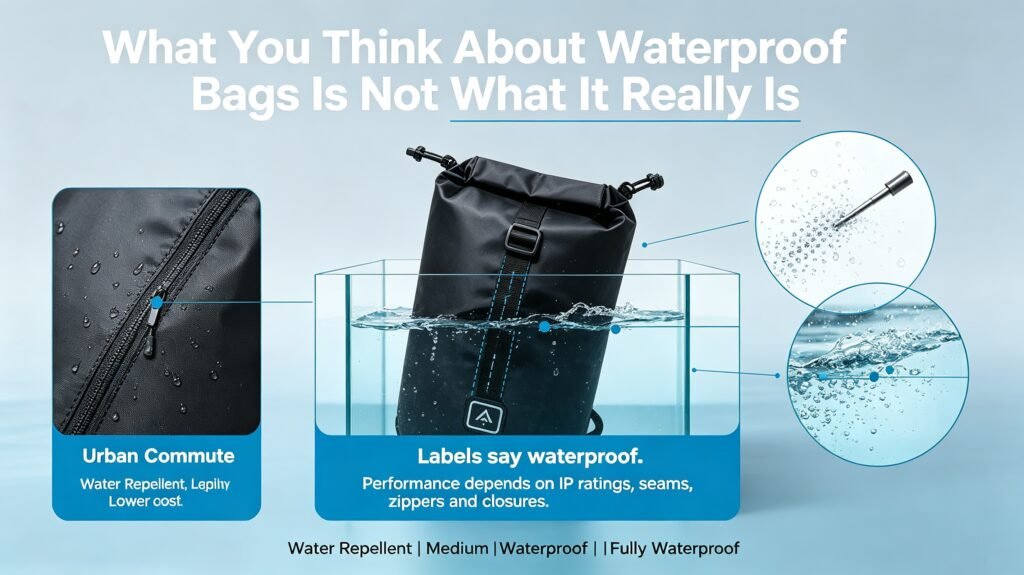
I. Opening: The “Waterproof” Label Problem
Every outdoor store and Alibaba supplier seems to slap “waterproof” on their bags these days.Buyers see “waterproof” on a tag and picture gear that’ll laugh at rainstorms, survive river crossings, maybe even a drop in the lake. Here’s the wake-up call: about 80% of bags with that label start leaking the second real weather hits. For procurement teams, that “small issue” turns into return piles, furious customers, and your brand taking a beating.
Marketing keeps things neat and simple. Reality doesn’t. “Water repellent,” “waterproof,” and “fully waterproof” sound like different ways to say the same thing, but they aren’t even in the same ballpark. Get them mixed up and you’re literally paying for it.
The truth is messier than the marketing. “Water repellent,” “waterproof,” and “fully waterproof” aren’t fancy ways of saying the same thing. They’re completely different categories, and mixing them up costs money.
II. Three Levels of Protection (And Why They Matter)
Water Repellent: The Label Lie You See Everywhere
These bags shrug off a few raindrops or a spilled coffee. That’s it. Makers use regular fabric with a thin PU coating and call it a day—no sealed seams, no special zippers. Fine for walking to the subway or a quick dash to your car. But leave one out in steady rain? Your stuff gets wet. Suppliers love playing word games here, slapping “waterproof” on tags when “water-resistant” would be honest. If you source bags regularly, you’ve seen this bait-and-switch dozens of times—tough-looking packs that dissolve in real weather.
Medium Waterproof: Where Most Outdoor Gear Actually Lives
These handle proper rain and can take a quick dunk—think 30 minutes max. The build uses coated nylon or PVC, plus taped seams and actual waterproof zippers. Many skip formal IP ratings, but decent ones hit IPX5 or IPX6 (that means they can take a jet of water without leaking). Good for hiking, biking, anything where your gear faces hours of wet conditions. Most of the outdoor bags you’ll source fall into this bucket.
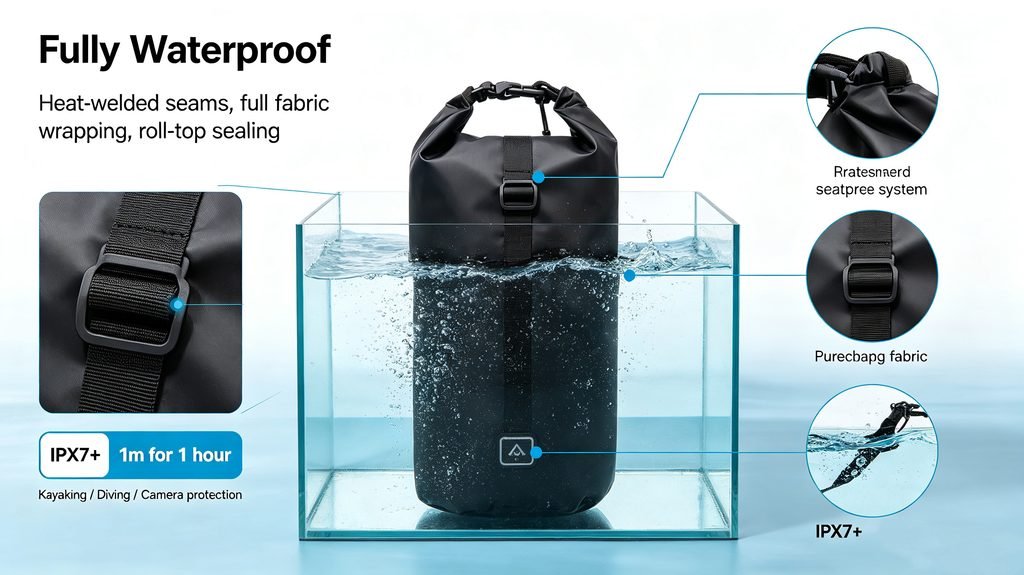
Fully Waterproof: The Real Deal for Serious Conditions
This is the only category that can sit underwater and stay dry inside. The construction tells the story: heat-welded seams instead of stitching (no holes), complete fabric wrapping, and roll-top closures or specialized sealing systems. They carry IPX7 or higher—tested to survive one meter down for over an hour. Kayaking, diving support, protecting cameras in monsoons—this is what you actually need. The jump in price is real, but so is the performance gap.
III. How to Identify Genuine Waterproof Quality
Check the Label for Two Critical Details
First, look for IP waterproof ratings. IPX5 and above indicate genuine jet water resistance; IPX7 or IPX8 confirms submersion capability . Second, examine construction descriptions. Phrases like “seamless heat pressing,” “fully sealed,” “waterproof zipper,” and “seam taping” signal proper engineering. Absence of these terms suggests superficial water resistance only.
Inspect Three Often-Overlooked Weak Points
Seams represent the first failure point. Without taping strips, needle holes allow water penetration regardless of fabric quality. Zippers create the second vulnerability—even waterproof fabrics fail if paired with standard zippers. Third, examine opening designs. Roll-top closures indicate serious waterproofing; basic buckles suggest water-repellent level protection at best. These details separate genuine waterproof products from pretenders.
Watch for Common Supplier Tactics
Some manufacturers highlight “waterproof fabric” while ignoring overall construction quality. Fabric waterproofing means nothing if seams leak. Others deliberately blur IP ratings or exaggerate capabilities—claiming “diving-grade” protection without IPX8 certification. Always request third-party test documentation rather than trusting marketing materials. The IEC 60529 standard provides objective benchmarks that cut through promotional language .
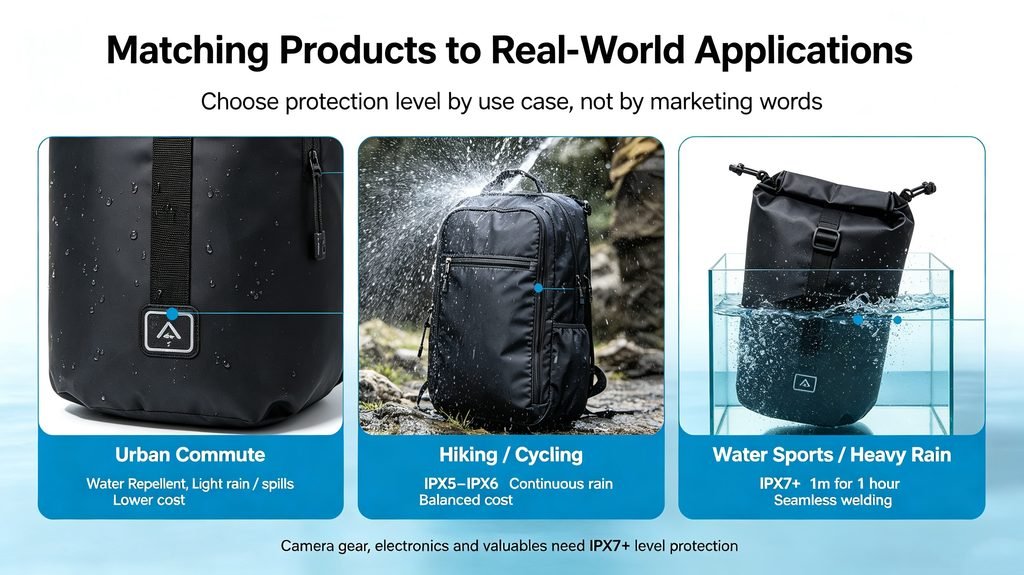
IV. Matching Products to Real-World Applications
For daily commuting and urban use, water-repellent bags offer adequate protection at lower cost. Outdoor hiking and cycling demand medium waterproof ratings—IPX5 to IPX6 handles continuous rain without premium pricing. Water sports, heavy rain environments, and equipment protection require fully waterproof construction with IPX7+ ratings and seamless welding. Camera gear, electronics, and valuable equipment especially need this level of protection.
V. Conclusion: Making Informed Procurement Decisions
True waterproof performance depends on IP ratings plus construction details—not single marketing words. Match protection levels to actual use cases rather than defaulting to maximum ratings. Over-specifying increases costs unnecessarily; under-specifying creates liability and customer dissatisfaction.
At Quanzhou Langmu International Trade Co., Ltd., we operate a 15,000-square-meter modern manufacturing facility with over 300 dedicated staff members. Our six conventional production lines and nearly 200 sets of advanced automatic equipment ensure consistent quality and efficient output. We maintain full compliance with ISO 9001:2015, BSCI, SEDEX, and other international standards—certifications that matter when you’re vetting suppliers for retail partnerships . Whether you need water-repellent commuter bags or IPX8-rated diving dry bags, our engineering team delivers products that match specifications—no marketing exaggeration required. Contact us to discuss your specific waterproof protection requirements and receive detailed technical documentation for your procurement evaluation.