
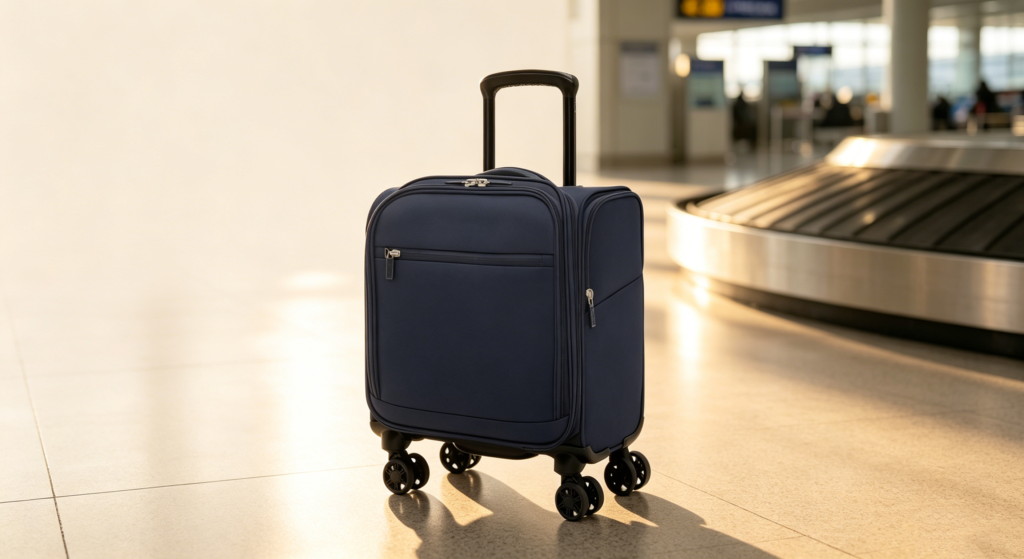
At any airport, you see two kinds of travellers. One pulls a shiny hardshell bag. The other carries a fabric suitcase that looks like it’s been around the world a few times.For the past decade, hardshell luggage has been the darling of travel influencers and department stores alike. Yet step into the crew lounge or chat with a pilot who flies 200 days a year, and you’ll hear a different story. Softsided luggage isn’t just hanging on — it’s making a serious comeback. And the reasons run far deeper than nostalgia.
What Made the OldSchool Soft Suitcase a Tank
Before lightweight plastics and injectionmoulding, luggage was built by people who expected it to last a lifetime. The classic canvas or nylon suitcase operated on a simple principle: give the bag some “give.” Instead of a rigid shell that cracks under pressure, oldschool soft luggage used an internal armature — often wood or light steel — to provide shape, while the outer fabric took the beating. Drop it, kick it, stack three more bags on top — the fabric absorbed the shock and the frame kept everything from collapsing.
The materials were chosen for sheer endurance. Think heavyduty canvas, thick cotton duck, or densely woven nylon that could scrape against conveyor belts without tearing. Corner reinforcements were standard, usually leather or metal, because those points always hit the ground first. And because the construction relied on stitching rather than moulds, repairs were straightforward. A burst seam? Stitch it up. A broken zipper? Swap in a new one. A handle that frayed? Replace it. Hard shells, for all their sleek lines, offer no such second act — once polycarbonate splits, the suitcase is usually destined for landfill.
What Soft Luggage Does Better
Lighter than hard shells, soft bags make a real difference when you’re hauling them around — and airlines do check those weight limits.
It also gives you room to spare when you overpack. The fabric stretches a little, and many models have expansion zippers that add extra depth. That extra inch or two makes a real difference when you’re bringing back gifts or bulky coats.
Getting things out is simpler too. Outside pockets hold your passport, phone, or a light jacket. You don’t have to lay the whole bag flat and unzip everything just to grab one item.
Scratches don’t show the way they do on shiny plastic. A fabric surface hides scuffs, so your bag still looks decent after years of travel.
Soft bags also squeeze into tight spots — packed overhead bins, small car boots, or under a bed. That’s why frequent flyers and cabin crew often prefer them.
Now, if you still picture soft luggage as a bulky, dullcoloured holdall from the 1990s, take another look. A lot has changed. Some of the brands that used to only make hard shells now sell fabric bags too. And they don’t look like they belong in a camping store anymore.
The fabrics are tougher — tearresistant nylons, better coatings that actually keep rain out. The designs are cleaner, not so boxy. You get laptop sleeves, compression straps, pockets that are useful without being ugly. Colours are more muted too — less bright red or neon, more like what you’d actually want to carry through an airport.
It’s the same old softside idea, but the execution is just … better.
Where Quality Manufacturing Fits In
All these design and material improvements only matter if the bag is made well. At Quanzhou Langmu International Trade Co., Ltd., we run a 15,000squaremetre factory with over 300 staff. We have six assembly lines and nearly 200 automated machines — computercutters, highspeed stitchers, and more — that help us keep tolerances tight and output consistent.
We don’t just stitch and ship. We test. Our quality team runs drop tests, zipper cycle tests, and abrasion checks on random samples from every batch. Our production processes meet standards including ISO 9001:2015, BSCI, SEDEX, WM, MGB, and SWISSGEAR. Every bag is inspected before it leaves the dock. That’s how we make sure it can handle the rough handling, the weather, and the constant use that real travel demands.
So, Does Soft Luggage Still Make Sense?
Yes. It always has. The old canvas suitcases lasted for decades because they were flexible, repairable, and light. The new ones keep those strengths and add better fabrics, sharper looks, and smarter interiors. They pack more, weigh less, and hide the scuffs that ruin glossy shells. And when a zipper or handle wears out, you can fix it — something you can’t do with a cracked polycarbonate case.
For frequent travellers, weekenders, or families, a wellmade softsided bag is a practical choice. When it comes from a factory that holds recognised certifications and tests every batch, you know it’s built to last. That’s not nostalgia — that’s simply good value.