
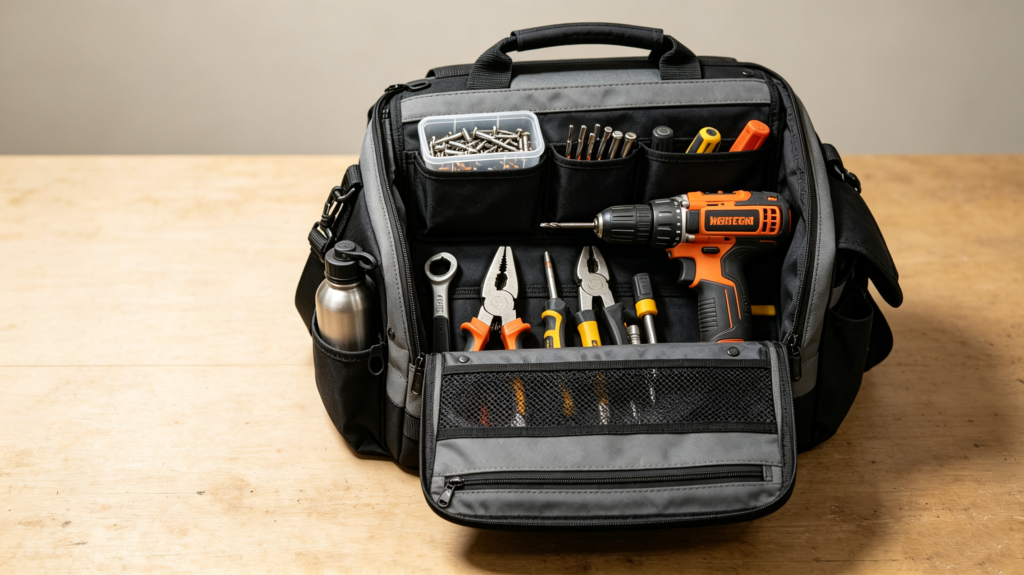
Most professionals have experienced the frustration: standing on a job site, gloves on, knowing exactly which tool you need—and spending two minutes digging through a cavernous main compartment to find it. The tool bag itself is fine. The pocket design failed.
I’ve learned that pocket configuration matters more than brand label or shell material. A well-pocketed bag saves twenty minutes per day. Over a career, that’s weeks of recovered time.
First Principles: What Pockets Actually Do
Pockets aren’t just storage compartments. They’re access architecture. Three principles guide effective design:
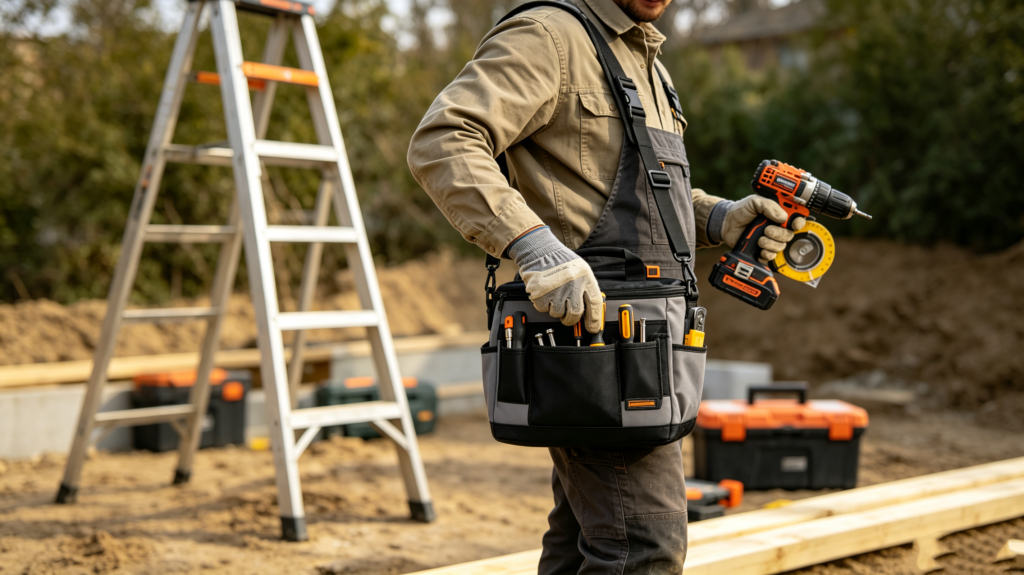
Reach without strain. Frequently used tools belong in front or side pockets, not buried in the main compartment. The shoulder rotation required to access a back pocket determines whether a tool gets used or ignored.
Dimensional precision. Loose pockets let tools shift, collide, and damage edges. Overly tight pockets create extraction friction. Each pocket should match a specific tool’s silhouette with 10-15% clearance for gloved hands.
Load distribution. Heavy tools positioned high or outward create torque on the carrier’s back and shoulders. Weight sinks low and close to the spine. Pocket placement is biomechanics, not aesthetics.
Pocket Types and Their Functions
Small item containment
Screws, nuts, drill bits, and fasteners disappear in undifferentiated space. Dedicated small pockets with elastic retention or zipper closure prevent migration. We specify 200D nylon lining with bartack reinforcement at stress points—small pockets tear first because users overstuff them.
Hand tool slots
Pliers, screwdrivers, and wrenches need vertical orientation, handles accessible, jaws protected. Individual slots with elastic loops or hook-and-loop tabs maintain separation. Dividers prevent metal-on-metal contact that dulls cutting edges.
Power tool housing
Drills, impact drivers, and angle grinders generate concentrated load. These pockets require padded walls, reinforced bases, and often external mounting to preserve internal volume. We use 1680D ballistic nylon with TPU backing for these applications—our ISO 9001:2015 testing includes 50,000-cycle abrasion validation.
Specialized solutions
Long tools—hammers, levels, pry bars—need holster-style pockets with drop prevention. Cables and hoses store well in mesh pockets that provide ventilation and visual inventory. Small electronics demand waterproof zipper compartments with padded lining, positioned high to avoid ground moisture.
Design Tactics for Real Workflows
Front-load your frequency
The tool used every ten minutes lives in a front pocket, no cover, single-hand access. The tool used twice daily tolerates a zippered side compartment. The emergency tool—multimeter, spare blade—can bury deeper. Map pocket accessibility to actual usage patterns, not hypothetical organization.
Prevent internal migration
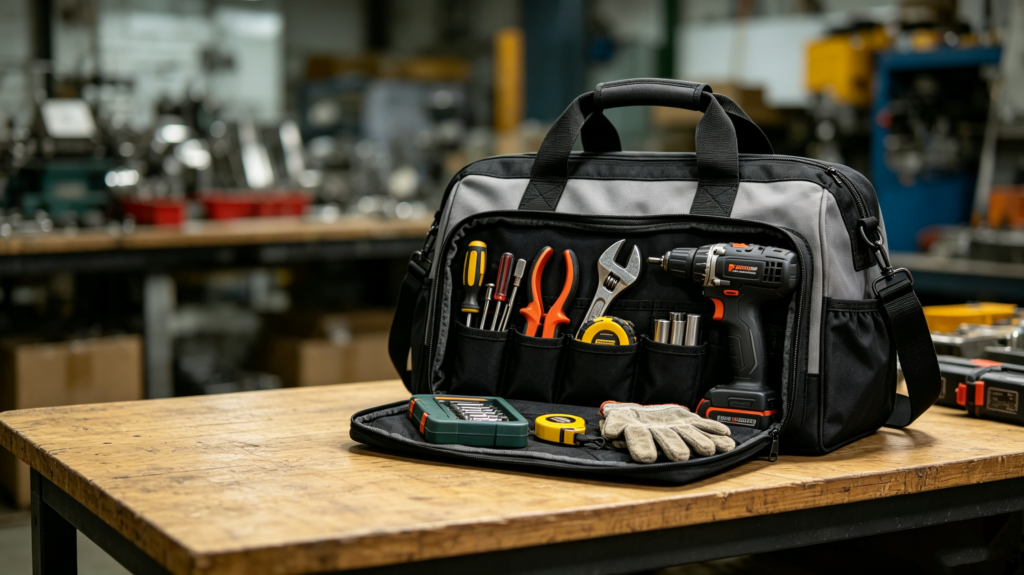
Dividers and elastic loops cost pennies and save hours. Without them, tools settle to bag bottom in chaotic layers. Vertical organization through slot dividers maintains tool position during transport and allows visual inventory at a glance.
Balance the load
A bag with heavy power tools in upper pockets pulls backward, straining shoulders and reducing stability on ladders. Position weight low and centered. External pockets for bulky items preserve internal organization while maintaining center of gravity.
Calibrate for trade
Electricians need numerous small pockets for terminals, wire nuts, and testers. Carpenters prioritize chisel slots and hammer loops. HVAC technicians require space for manifold gauges and temperature probes. Generic “multi-trade” bags compromise everyone. Custom pocket arrays for specific professions outperform universal designs.
Manufacturing Reality
Pocket durability depends on construction details invisible in marketing photos. We specify:
Bar-tack stitching at all strap attachment points—300% density of standard seams
Binding tape on pocket edges to prevent fraying
Reinforced box corners where vertical and horizontal stresses concentrate
YKK or equivalent zippers with water-resistant coating for exterior pockets
Our BSCI and SEDEX-certified production lines separate tool bag manufacturing from soft luggage to prevent cross-contamination of quality standards. WM, MGB, and SWISSGEAR certifications require documented pull-testing and cycle validation.
The Bottom Line
Tool organization isn’t about neatness. It’s about cognitive load. Every second spent searching for the right tool breaks concentration, extends job duration, and increases fatigue. Well-designed pockets return mental bandwidth to the actual work.
Custom pocket configuration—matched to specific tools, user body mechanics, and professional workflow—transforms a bag from passive container to active productivity tool. That’s the difference between a product and a solution.
Quanzhou Langmu International Trade Co., Ltd. operates a 15,000-square-meter manufacturing facility with 300+ staff and nearly 200 automated equipment sets. We produce custom tool bags with pocket configurations tailored to specific trades and user requirements, certified to ISO 9001:2015, BSCI, SEDEX, WM, MGB, and SWISSGEAR standards. Contact our team to develop pocket arrays matched to your customers’ actual workflows.