
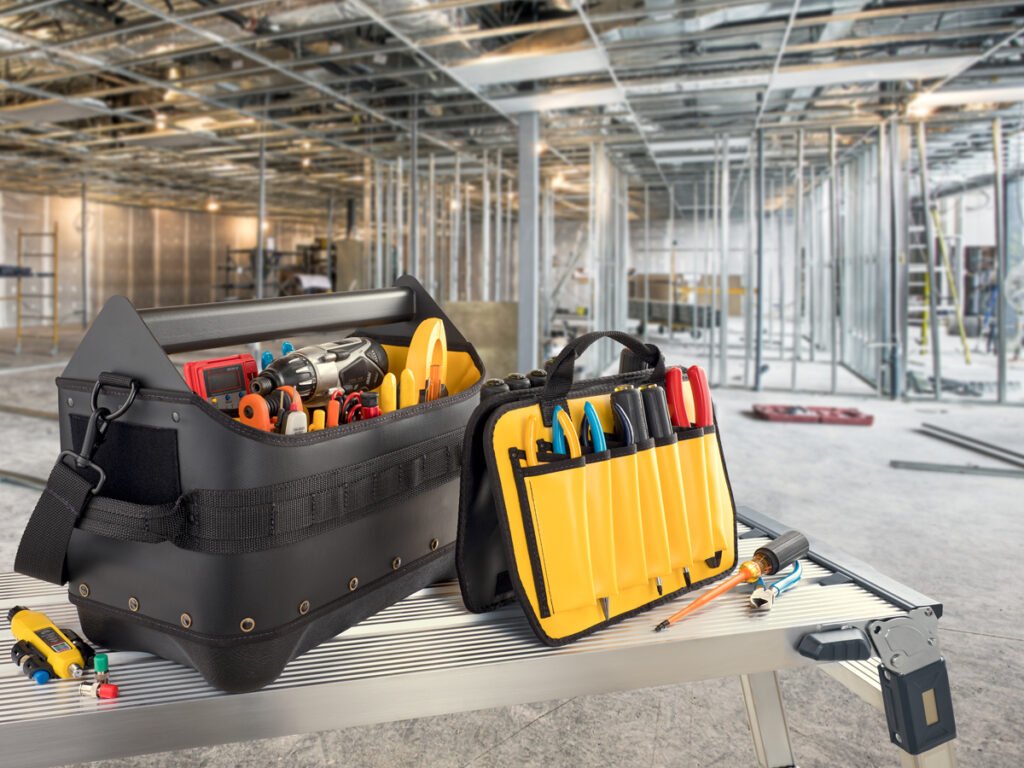
For anyone working in skilled trades, your tool bag is far more than just storage—it’s the backbone of your daily on-the-job performance. A cheap bag is a liability. It doesn’t just fall apart; it eats your time, beats up your expensive gear, and leaves you with a blown-out lower back before the lunch whistle even blows. For anyone making a living in the trades, a pro-grade rig isn’t a luxury—it’s a long-term investment in your own productivity. Spotting a winner isn’t about the color or the branding; it’s about looking past the surface to see if the hardware and the architecture can actually survive a real-world job site without folding under pressure.
The Textile Reality: Why 1000D Ballistic Nylon is the Floor
In the bag industry, we don’t just look at “thickness”—we look at abrasion resistance and tensile shear. A cheap polyester bag will shred at the first scrape with concrete or metal. A quality bag starts at 1000-denier ballistic nylon, engineered to resist tearing under extreme stress.We treat these high-density fabrics with a heavy polyurethane (PU) coat. On job sites, grease, fluid, and grit build up quickly; absorbent materials rot from the inside out. Professional-grade fabrics repel dirt, keeping the weave strong for years and remaining flexible in cold weather.
The “Dry-Dock” Base: More Than just Balance
The most overlooked failure point in a tool bag is the bottom. A fabric bottom soaks up moisture in damp crawlspaces or mud. A professional tool bag needs a blow-molded, hard-shell base—a “hydrostatic barrier.”This creates a dry zone for expensive impact drivers and multimeters, keeping them safe from groundwater. It also solves the “face-plant” problem: a rigid, weighted base ensures your bag stays upright when set down, protecting tools and keeping your workspace organized. It absorbs shocks and vibrations, keeping equipment secure during transport.
Hardware Duty-Cycles: The Pulse of the Bag
Most bags are returned for broken fasteners. Insist on hardware built for durability. Oversized, self-healing coil zippers clean debris as they move, preventing jams. If hardware feels tight in the store, it will seize up on site. A pro bag closes one-handed, even on a ladder. The pulls are oversized and textured, ensuring a secure grip with gloves or oily hands.
Organizational Logic vs. The “Black Hole”
Cheap bags are messy buckets. Tools stack, and you dig for the right wrench. A worthy bag uses vertical tiered pockets. This “Mise en Place” creates muscle memory—you stop searching and start indexing, reducing cognitive load.
Modularity matters. A bag with swappable pouches is worth twice a static one. Carry only what you need for a diagnostic call, leaving heavy tools in the vehicle.
Load-Path Ergonomics: Saving Your Career
Hauling 40+ pounds ruins backs if unengineered. Ignore soft padding; focus on the structural load path. A high-end pack uses a rigid internal frame and sternum strap to pull weight off the lumbar.
A flimsy back panel causes strain. Our straps wrap around the frame, so the bag’s architecture handles heavy lifting. This prevents shoulder digging and fatigue by noon.
The Psychology of Professionalism
High-end gear boosts client perception. An organized bag projects authority, showing you value quality work. A disorganized “junk bag” signals inefficiency. Investing in a premium bag builds your brand, letting you command higher rates as a controlled, professional expert.
Why the Manufacturing Source Defines the Strength
Quality is engineered, not accidental. At Quanzhou Langmu, we engineer bags in a 15,000㎡ facility combining craftsmanship and automated precision. Our team and machinery ensure structural tolerances beyond manual assembly.
We optimize stitch tension to prevent premature rips. Every run passes ISO 9001:2015, BSCI, and SEDAX protocols. This oversight makes us a trusted partner for global luggage leaders. Every bag leaves our floor after rigorous stress tests, built to perform when your paycheck is on the line.